Decks, sealed on the right cycle.
A deck in Golden sun ages faster than one in the metro. The water test tells you where yours is in about ten seconds.
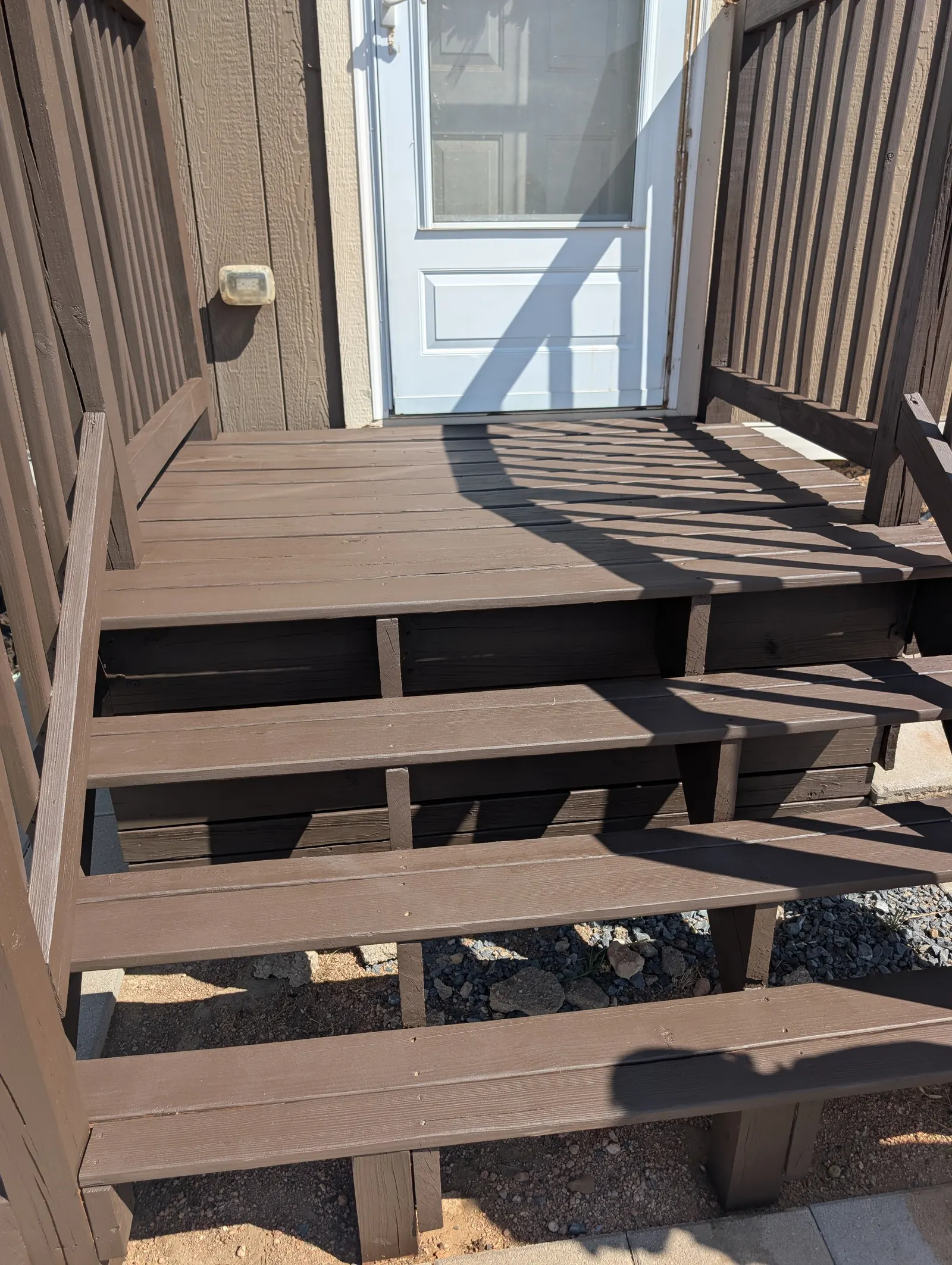
Painter Hotline stains decks, fences, railings and pergolas in Golden and up into the foothills. Boards are cleaned to strip the sun-grayed layer, brightened, dried and sanded where the grain stands up, then sealed with a penetrating stain picked for strong altitude UV and freeze-thaw. Walking surfaces get stain rather than paint. Book now for a spring date: 720-208-5645.
Ten seconds and a cup of water
Pour it on the boards. Beading means the seal is intact. Soaking in and darkening the wood means your deck is absorbing every storm and every snowmelt that lands on it.
In Golden that moment arrives sooner than people expect. Elevation raises the ultraviolet load, and an exposed south or west deck here can need attention in two years where a shaded one under mature trees might go four or five.
What happens before any stain opens
Taking the gray back. That silver surface is not dirt and soap will not touch it. It is wood fiber that ultraviolet destroyed, loosely attached to the sound wood below. Stain applied over it bonds to a layer already on its way off the deck.
Rebalancing the wood. Deck cleaners are strongly alkaline. They work, and they leave the timber chemically off-balance, which makes stain absorb unevenly with no visible pattern. A brightener restores the pH. This is the step most often skipped, and it explains most blotchy deck jobs.
Knocking the grain back. Washing stands the wood fibers up. Sanding flattens them so the surface is smooth underfoot and takes stain uniformly.
Stain, not paint, on anything horizontal
Paint sits on top as a film. A deck carries snow load, standing water and foot traffic, and that film eventually gives up. When it does, the next person has to strip the whole thing before starting, which is a far larger job than staining ever was.
Stain goes into the wood instead. It thins as it wears, so the next cycle is a clean and a recoat. If you ask us to paint your deck boards we will probably try to talk you out of it.
How much grain do you want to see?
That single question picks your product, and the trade-off running underneath it is always the same: the more wood you can see, the sooner you are back out here.
A transparent finish on new cedar is the most beautiful option and the shortest-lived, because there is very little pigment standing between ultraviolet and the wood. At Golden elevation that is a short honeymoon.
Semi-transparent is where most decks here end up. Enough pigment to slow the sun down, enough clarity that it still reads as wood. If you have no strong opinion, this is the answer.
Semi-solid hides color variation while keeping the texture, which is useful on a deck that has been repaired in patches or has boards from two different eras.
Solid looks like paint from ten feet away and lasts longest in appearance. It is also the hardest to walk back: going from solid to semi-transparent later means stripping, which is a project.
Fences are the one place we will push you toward solid without much hesitation, because they take abuse, nobody inspects the grain, and the longer cycle is worth more than the look.
Foothills timber
Up toward Lookout Mountain and Genesee the work changes character. Log and heavy-timber surfaces need penetrating stain systems plus attention to checking, the cracks that open as logs dry, and to chinking where it exists. Those cracks collect water, and a stain job that ignores them is cosmetic only.
What else we do in Golden
Interior painting
Walls, ceilings, trim, doors and basements throughout Golden.
Details →02Exterior painting
Siding, trim, fascia, soffit, doors and garage doors across Golden.
Details →03Historic home painting
Victorian, miner's cottage and early twentieth-century exteriors, with the submission handled.
Details →04Stucco painting
Stucco, masonry and mixed-substrate exteriors across Golden.
Details →05Cabinet painting
Kitchen and bathroom cabinet painting throughout Golden.
Details →Deck and fence staining questions
How often should a deck be stained in Golden?
Test with water rather than a calendar. When it stops beading and starts soaking in, it is time. Exposed decks at Golden's elevation often need attention every two to three years; shaded ones can go longer.
Why did my last deck stain come out blotchy?
Most often because the wood was not brightened after cleaning. Deck cleaners are alkaline and leave the timber chemically unbalanced, so stain absorbs unevenly with no visible pattern to it.
Should I paint my deck instead of staining it?
On the walking surface, no. Paint forms a film that eventually peels and then has to be stripped. Stain penetrates and wears away gradually, which keeps every future cycle simple.
Can a new deck be stained right away?
Sometimes. New pressure-treated lumber often needs to dry first, and how long depends on the lumber and the weather. We check moisture content rather than guessing.
Do you work on log homes in the foothills?
Yes. Log and heavy-timber surfaces need penetrating stain systems plus attention to checking and chinking, and products rated for the ultraviolet load at elevation.
Do fences need approval in a historic district?
Fences can count as exterior alterations in a designated district, so it is worth checking with city staff before a visible change. Staining an existing fence in the same tone is usually straightforward.
Request your free estimate
Send a few photos of the walls, deck or rooms, and tell us roughly how high up the hill you are. We can price most work from photos; log homes and steep lots are often worth a visit. Either way is free.
Rather talk it through? Call or text 720-208-5645