Deck stain at altitude.
Your deck faces more sun than almost any surface in Colorado. Here is how to make a stain job last up here.
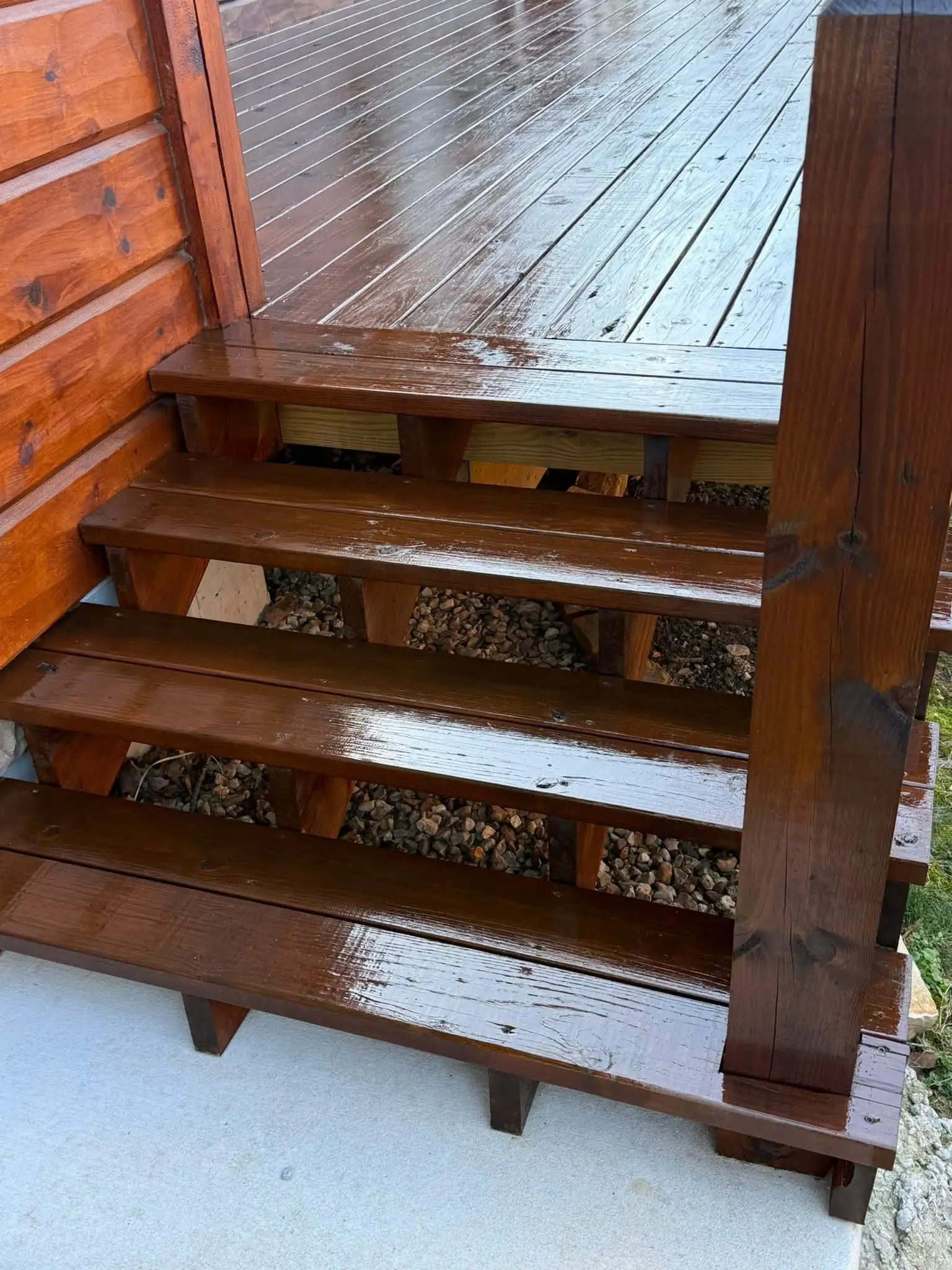
Deck stain wears out faster in the foothills because UV exposure rises roughly 2% per 1,000 feet and horizontal boards take sun, snow and foot traffic all at once. To make it last: clean off the gray fibers, brighten and dry the wood, sand raised grain, use a penetrating stain with enough pigment for UV protection, and plan a maintenance coat before the boards turn gray. Book in winter for a spring start.
Why decks fade first
A deck floor is flat to the sky. It takes direct sun for more hours than any wall, holds snow and meltwater on its surface, and gets scuffed every day. Add elevation: UV exposure climbs roughly 2% for every 1,000 feet, and Golden sits near 5,800 feet while Evergreen, Idaho Springs and Conifer sit above 7,000. Railings and vertical boards usually look fine long after the floor has faded.
Stain, not paint, underfoot
Film-forming paint and solid coatings sit on top of the boards. Where water pools and boots grind, they crack and peel, and peeling paint on a deck is a scraping job. Penetrating stains wear away gradually and can be re-coated after cleaning. That is why we put stain on walking surfaces.
How much pigment?
Clear and very light toners show off the grain but give the least UV protection, so they need re-coating sooner. Semi-transparent and semi-solid stains carry more pigment and generally hold their color longer on a sunny mountain deck. Sample on a few boards in full sun before deciding.
The prep sequence
- Clear the deck and protect plants and siding.
- Clean with a wood cleaner to lift dirt, mildew and gray fibers.
- Brighten to restore the wood’s color after cleaning.
- Let it dry thoroughly.
- Sand any fuzzy or raised grain, and set popped fasteners.
- Apply stain to the label’s coverage and back-brush it in.
When to do it
Stain labels list a minimum temperature, and the boards need to stay above it while the product soaks in and dries. Up the hill, cold nights shorten the useful days at both ends of the season. Late spring through early fall is the realistic window, and the earliest weeks book first. Winter is when to get on the list: send photos now and pick a spring date.
Signs your deck is due
- Water soaks in instead of beading.
- The floor is lighter or grayer than the railings.
- Splinters or fuzzy grain in the traffic lanes.
- Black spots of mildew in shaded corners.
Ready for a quote? See deck and fence staining in Golden or, for higher elevations, Evergreen, Conifer and Idaho Springs.
Sources: KOAA: how elevation affects UV · Wikipedia entries for Golden (5,784 ft), Evergreen (7,162 ft), Idaho Springs (7,526 ft) and Conifer (8,262 ft)
Deck stain questions
Why does my deck stain fade so fast in Colorado?
Decks face the sky, hold snow and take foot traffic, and UV exposure rises roughly 2% per 1,000 feet of elevation. Foothill decks get more UV than decks on the plains.
Should I paint or stain my deck?
Stain the walking surfaces. Paint and solid film coatings tend to peel where water sits and people walk.
When is the best time to stain a deck in the foothills?
Late spring to early fall, on days when the boards stay above the stain’s minimum temperature while it dries. Book in winter to get an early spring date.
How do I know if my deck needs staining?
If water soaks in instead of beading, or the floor is grayer than the railings, it is due.
Request your free estimate
Send a few photos of the walls, deck or rooms, and tell us roughly how high up the hill you are. We can price most work from photos; log homes and steep lots are often worth a visit. Either way is free.
Rather talk it through? Call or text 720-208-5645