Tongue-and-groove ceilings: paint, stain or whitewash?
Wood ceilings and beams in Golden homes, finished to last at altitude.
By Painter Hotline · Published
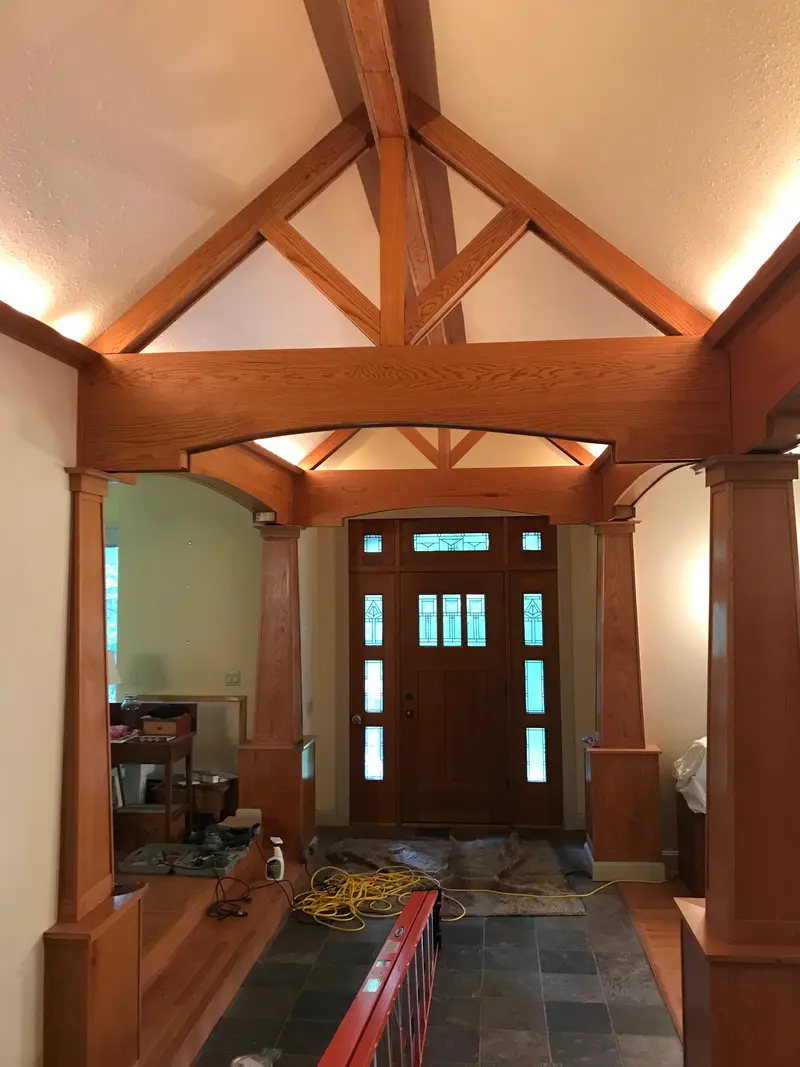
Stain or a clear coat keeps the grain; paint brightens a dark room and hides ambered pine but is close to permanent; whitewash sits in between and softens rather than hides. Whichever you pick, block tannins and knots with a shellac or stain-blocking primer before any light color, let the boards move instead of caulking the joints, and plan for extra sun fading near big west windows at Golden’s elevation.
Three finishes, three different ceilings
A lot of houses in Golden, from 1970s split-levels in Applewood to newer builds up toward Lookout Mountain, have at least one room with a wood ceiling: knotty pine or cedar tongue-and-groove over the great room, beams across a vaulted living room, a porch ceiling that continues inside. Sooner or later the owners ask us: keep it wood, or paint it?
| Finish | Looks like | Best when | Trade-off |
|---|---|---|---|
| Clear coat or stain | Wood grain, warm tone | The wood is in good shape and the room gets plenty of light | Ambers and fades with sun; refinishing overhead means sanding |
| Whitewash or pickling | Grain showing through a soft white or gray | You want lighter without losing the wood character | Translucent, so knots and orange tones still show; test first |
| Paint | Solid color, board lines still visible | The room feels dark, the wood is orange or mismatched | Near permanent on tongue-and-groove; needs a blocking primer |
Clear or stain is the most honest to the material, and it is what makes a mountain home feel like one. It is also the finish that changes most over time. Clear-coated pine darkens toward orange, and a ceiling with a decade of afternoon sun on one end and none on the other will not match itself. Refreshing it means sanding and recoating from scaffolding.
Whitewash is a thinned white stain or a diluted paint wiped into the wood. It can turn a heavy ceiling airy, but it is translucent, so what is underneath matters. On deeply ambered boards it can turn pinkish or muddy, so we always test a hidden corner first.
Paint is the biggest change and the hardest to undo. Once primer and paint get into the grooves and V-joints of tongue-and-groove, there is no practical way to strip back to bare wood. Be sure before you paint, and if you are on the fence, paint the walls first and live with the ceiling for a month.
Beams are their own decision
Exposed beams are often rough-sawn and carry deep seasonal cracks, called checks. Those cracks open and close with humidity and are part of the beam, not damage. We don’t fill them with caulk, which only splits out again. A solid-color stain or a flat paint suits rough beams; a gloss coat on rough wood shows every fiber. Many owners keep beams stained and paint the ceiling between them.
Tannin bleed and knots: why the paint turns brown
Cedar and redwood contain tannins, natural compounds that dissolve in water. Pine knots carry resin. When you roll water-based paint straight onto either, the water pulls those compounds up into the film, and a week later the white ceiling has tan halos around every knot and brownish streaks down the cedar boards.
What works:
- Clean and degloss. Old clear finishes get washed to remove kitchen grease and dust, then scuff-sanded so the primer can bite.
- Spot-prime knots with shellac. Shellac-based primer is the dependable knot sealer. Bad knots get two coats.
- Prime the field with a stain-blocking primer. On cedar especially, the whole surface gets a blocking primer, oil-based or shellac-based, not just the spots you can see today.
- Two finish coats. A flat or matte ceiling finish hides the slight unevenness between boards better than eggshell.
Already painted and bleeding? Same answer: spot-prime with shellac, then repaint. Our interior painting crews carry shellac primer on every wood-ceiling job for this reason.
Sun through big west windows, at 5,675 feet
Golden sits at about 5,675 feet. The World Health Organization says UV levels rise by roughly 10 to 12 percent for every 1,000 meters of altitude, which puts Golden in the range of about 17 to 21 percent more UV than sea level under the same sky. That is an estimate, and the chart shows the math.
Source: World Health Organization, ultraviolet radiation fact sheet; city elevations rounded.
Window glass cuts some of that, but not all of it, and the foothills give many Golden living rooms large west-facing glass aimed at the mountains. Clear finishes and lightly pigmented stains fade and amber fastest; solid stain and paint, with more pigment, hold their color better.
Winter can be the stronger season for this. WHO notes that fresh snow can reflect as much as 80 percent of UV. A snowy yard bounces light up through the glass and onto the underside of the ceiling, a surface that never sees direct sun in summer. Our post on why paint fails faster at elevation covers the same forces on the outside of the house.
Dry winter air and boards that move
Denver Health points out that humidity is lower at altitude and drops further in winter. Trane notes that low humidity makes wood trim and floors contract and crack. Tongue-and-groove boards do the same thing across their width, and that movement is the reason for two common complaints:
- Unpainted stripes. A ceiling painted in summer, when the boards were at their widest, will show thin bare lines in January as each board pulls back and exposes a sliver of tongue. Painting in winter, with the boards at their narrowest, lets the finish reach those strips.
- Cracked caulk. Someone caulked the joints to make it look like drywall, and every joint split the first dry season. Tongue-and-groove needs its joints open.
A whole-house humidifier set to a modest level softens the swing, though it won’t stop it. Above Golden, in Evergreen and Conifer, the air is even drier; see our Evergreen and Conifer page if your house is up the hill.
Working overhead in winter
Wood ceilings are the slowest part of any interior, because every groove has to be filled with finish. Winter gives the job the days it needs. What we plan for:
- Access. Vaulted great rooms usually need a rolling scaffold tower rather than ladders. Furniture leaves the room, not just the middle of it.
- Spray, then back-brush. Spraying gets primer and paint into the V-grooves; a brush right behind it works the finish in and evens it out. That means masking the whole room, walls included.
- Heat and air. Heat collects at the peak, so a high ceiling dries quicker at the top than near the walls; we keep a wet edge to avoid lap marks. The furnace fan stays off while we spray, and fans move fumes out a cracked window.
- Ceilings first. Anything that drips lands on walls that haven’t been painted yet.
- Older homes. If the house was built before 1978 and the ceiling is already painted, sanding it is work that can disturb lead paint. EPA’s RRP rule requires certified, lead-safe practices once disturbed interior paint goes past 6 square feet.
The broader list of what to tackle inside this season is in winter interior projects for foothill homes. If the cedar outside the same windows is fading too, see cedar and log siding staining.
We are glad to look at the ceiling in person, or you can send photos and get a price without a visit; you choose. Painting projects booked by December 31, 2026, receive 25% off the labor, with paint and materials priced separately. Call 720-208-5645 or request a free estimate.
Wood ceiling and beam questions
Should I paint or stain a tongue-and-groove ceiling?
Stain or a clear finish if you love the grain and the room has enough light; paint if the wood has gone orange, the room feels dark, or the boards are mismatched. Paint is close to permanent on tongue and groove, because stripping it back out of every groove is rarely practical, so sample on a loose board or a hidden corner first.
Why are brown spots coming through my painted wood ceiling?
Those are tannins or knot resin bleeding through the paint. Cedar and redwood carry water-soluble tannins, and pine knots hold resin, and both can travel up through a latex topcoat. The fix is to spot-prime the stains with a shellac-based primer, or prime the whole ceiling with a stain-blocking primer, then repaint.
Why do unpainted lines show between my ceiling boards in winter?
Tongue-and-groove boards shrink across their width when indoor air dries out in winter, and each board pulls back from its neighbor and exposes a strip of the tongue that was hidden when the ceiling was painted. Painting in winter, when the boards are narrowest, and working paint into each joint keeps those stripes from appearing.
Should the gaps between ceiling boards be caulked?
No. Tongue-and-groove is designed to move with the seasons. Caulk in the joints either tears as the boards shrink or locks them so they buckle when they swell. Leave the joints open and make sure the finish reaches into them instead.
Can you whitewash a knotty pine ceiling that has turned orange?
Often, but the result depends on the board. A whitewash is translucent, so it softens the orange rather than hiding it, and knots stay visible. On heavily ambered pine we test a section first; if it still reads too warm, a stain-blocking primer and a soft white paint is usually the better route.
Figures on this page come from the sources below. The UV range for Golden is our estimate from the WHO rate.
- Ultraviolet radiation fact sheet, World Health Organization (UV rises about 10–12% per 1,000 m; fresh snow reflects up to 80%).
- Indoor air and humidity at altitude, Denver Health (lower humidity at altitude, lower still in winter).
- Home humidity guidance, Trane (low humidity shrinks and cracks wood trim and floors).
- Renovation, Repair and Painting Program, U.S. Environmental Protection Agency.
Request your free estimate
Send a photo of the ceiling from each end of the room and one close-up of the wood. We can price from photos, or come measure and look at the boards in person. Your choice, and free either way.
Rather talk it through? Call or text 720-208-5645